
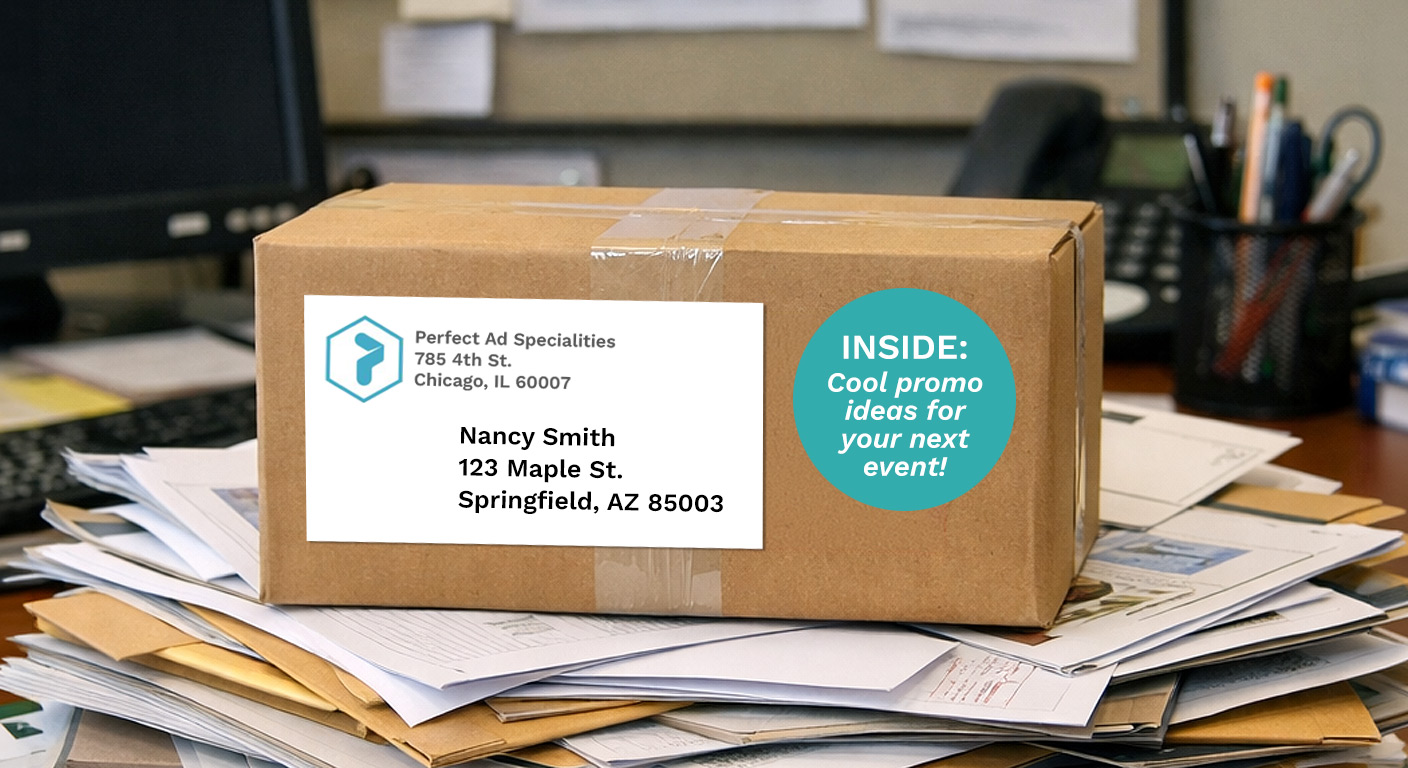
Your direct mail piece arrives in a stack with invoices and promotional offers. What makes someone open your envelope instead of tossing it, unopened, into the “circular file”? The answer increasingly involves dimensional mail that includes promotional products, creating curiosity impossible to ignore.
Packages with tangible items inside generate open rates 80% higher than standard direct mail, helping recipients feel valued and appreciated. This approach builds trust and connection while creating memorable brand experiences that digital channels can’t replicate. The promotional item provides immediate value, and your message delivers information, creating brand associations that stick and drive responses that justify the investment.
Let’s explore how pairing direct mail campaigns with strategic promotional products can transform your marketing results and create memorable touchpoints that move prospects through your sales funnel.
Why Dimensional Mail Outperforms Flat Mailers
Human psychology responds powerfully to physical objects in ways that flat paper never achieves. When people receive packages, they experience curiosity about contents, anticipation during opening, and appreciation for unexpected gifts. These emotional responses create positive brand associations before recipients even read your marketing message.
Dimensional mail also benefits from practical advantages throughout the delivery journey. Postal workers handle packages differently from letters. They’re less likely to bend, damage, or lose items with obvious dimensional presence. Recipients notice packages immediately as they sort through the mail. Packages with weight and shape stand out visually and tactilely in ways flat envelopes never can. The novelty and scarcity of dimensional mail make it inherently more interesting.
Response rates tell the real story. Studies consistently show dimensional mail generating 3-5 times higher response rates than flat direct mail. While initial costs per piece are higher, it can significantly lower your overall cost per response, making it a more efficient investment for your marketing budget.
Choosing Promotional Products for Direct Mail Success
Understanding which products resonate most helps you choose items that maximize engagement and ROI.
Useful promotional products generate better responses than novelty items. Recipients immediately see the value in branded phone wallets, cable organizers, or multi-tools. These items solve real problems people face daily, creating positive associations with your company every time they use them.
Relevant items aligned with your product or service reinforce your marketing message. If you’re selling financial services, branded calculators or money clips make thematic sense. If you’re marketing home services, measuring tapes or level tools create natural connections. This alignment between promotional products and your offering strengthens overall campaign coherence.
Quality matters because the promotional product often provides recipients’ first tangible interaction with your brand. Items that break immediately or feel flimsy communicate poor quality standards. Premium items that feel substantial and well-made suggest you deliver quality products or services as well.
Personalization, such as including recipients’ names or tailoring messages, demonstrates genuine investment, making prospects feel recognized and boosts the likelihood of a response.
Additionally, compact items control shipping costs while still creating a dimensional presence. Quality pens, branded USB drives, small tech accessories, or useful tools all fit in relatively flat packages, avoiding expensive shipping rates. These items provide genuine utility while keeping campaign costs manageable.
Creating Effective Direct Mail Campaigns with Promotional Products
Successful campaigns integrate promotional products strategically. The relationship between your promotional product, your message, and your call to action determines whether campaigns drive responses or waste budgets.
Lead with the promotional product when designing your campaign. Don’t treat it as an afterthought. Your envelope copy should tease what’s inside, creating curiosity that drives opening. Your letter should acknowledge the gift immediately and naturally connect it to your value proposition.
Connect promotional products to your message thematically. If your message is to “shred light” on solutions to prospects’ problems, send a branded flashlight. If your message speaks to “decluttering”, include desktop organizer. These thematic connections make campaigns feel cohesive.
Time campaigns around your sales cycle or industry calendar. Sending promotional products that align with seasonal needs or business cycles increases relevance. Dimensional mail promoting tax services makes sense well before tax season. Campaigns targeting year-end budget spending should arrive when companies are making those decisions.
Segment your audience carefully. Target your highest-value prospects, warmest leads, or most important existing customers rather than mass-mailing contacts on purchased lists. This approach works best with audiences where higher per-piece costs make sense given potential returns.
Follow up persistently because dimensional mail creates opportunities for continued engagement. The promotional product gives you natural reasons to reconnect. “Did you receive the branded calculator we sent?” is an easier conversation starter than “Just following up on our mailer.” Tangible items provide hooks for sales conversations that purely digital or paper marketing never offers.
Track results using unique codes, personalized URLs, or dedicated phone numbers to demonstrate your commitment to success and give recipients confidence in your strategic approach. Since dimensional mail campaigns involve higher upfront costs, showing ROI reassures senior management that the investment is justified and effective.
Promotional Products for Different Direct Mail Objectives
Different campaign objectives call for different promotional product strategies. The right approach depends on whether you’re generating leads, nurturing prospects, closing deals, or building customer loyalty.
Lead generation campaigns work well with lower-cost, quality promotional products that create dimensional presence without breaking budgets. Pens, magnets, keychains, or small tech accessories provide enough value to drive initial responses without requiring massive investment in unqualified audiences. These items open doors for sales conversations while keeping acquisition costs reasonable.
Prospect nurturing benefits from higher-value promotional products that demonstrate growing investment as relationships develop. Early touches might include modest branded items. Later campaign stages could feature premium drinkware, high-quality apparel, or carefully curated gift sets, demonstrating increased commitment to winning their business. This escalating value mirrors the deepening relationship and growing deal potential.
Deal closing sometimes justifies significant promotional product investment when you’re competing for major contracts. A thoughtfully chosen premium gift arriving at the right moment can differentiate your proposal from competitors. When opportunities represent six- or seven-figure values, spending hundreds on distinctive branded items that influence final decisions makes strategic sense. The approach works especially well when paired with corporate gifts that go beyond the usual vendor options.
Customer retention and upselling campaigns leverage promotional products to maintain relationships with customers who have already generated revenue. Thank-you gifts that acknowledge loyalty, anniversary items that celebrate relationship milestones, or new product launch packages all strengthen existing bonds while creating opportunities for expanded business. These campaigns generate some of the highest ROI because you’re marketing to audiences with proven purchase history.
Industries Where Direct Mail Plus Promotional Products Excels
Certain industries and business models benefit strongly from combining direct mail with promotional products. The approach works remarkably well in contexts where personal relationships, trust, and differentiation determine success.
Financial services struggle with commoditization, in which prospects see little difference among providers. Dimensional mail with promotional products creates memorable differentiation. A branded portfolio organizer from a wealth management firm demonstrates attention to detail. A mouse pad imprinted with a list of documents to retain from an accounting practice suggests an understanding of the prospect’s concerns. These products cut through the clutter that financial services marketing constantly fights.
Professional services such as law, consulting, or engineering face challenges in standing out among competitors with similar qualifications. Dimensional mail demonstrates creativity and initiative that flat brochures can’t communicate. This approach works especially well for winning high-value engagements where differentiation matters more than cost.
Healthcare and senior services target audiences bombarded with marketing but highly responsive to personal touches. Quality promotional products show genuine care beyond transactional marketing. Useful items that make daily life easier resonate strongly with these audiences. The tangible nature of promotional products builds trust in industries where skepticism about marketing runs high.
Generally, companies with long, complex sales cycles benefit from dimensional mail that maintains engagement across months or quarters. Promotional products serve as physical reminders of your company while prospects evaluate options, build internal consensus, and navigate approval processes. Your branded item sitting on their desk keeps your company visible throughout these extended timelines.
Measuring Direct Mail Campaign Performance
The costs involved in dimensional mail make measurement essential. You need clear data showing whether promotional products justify their expense through improved response rates and better cost per acquisition.
Set clear benchmarks before launching campaigns. What response rates do your current flat mailers generate? What does each qualified lead or new customer cost to acquire through various channels? These baselines let you evaluate whether dimensional mail, including promotional products, improves results enough to justify the increased upfront costs.
Track multiple metrics beyond just response rates. Monitor how dimensional mail influences sales cycle length, deal sizes, conversion rates, and customer lifetime value. Sometimes promotional products don’t dramatically increase initial responses but shorten the time to close or increase average deal value. These secondary impacts often justify the investment even when response rates alone look only marginally better.
Test variables systematically by trying different promotional products, messaging approaches, and audience segments. Maybe premium drinkware outperforms tech accessories for your audience. Certain prospect segments respond dramatically better to dimensional mail, while others show minimal improvement. Testing reveals what works for your specific situation rather than relying on general best practices.
Calculate true ROI, including all costs. Factor in promotional products, shipping, design, printing, and labor when determining total campaign investment. Compare these all-in costs against revenue generated from responses. Strong dimensional mail campaigns often show a 5:1 or better return on investment when executed strategically with the right audiences.
Compare channels to determine where dimensional mail fits your overall marketing mix. It rarely makes sense to convert your entire direct mail budget to dimensional approaches. But targeting your highest-value segments or warmest prospects with promotional product campaigns while continuing flat mail for broader audiences often creates optimal results.
Making Direct Mail Work Harder with Strategic Promotional Products
The promotional products you choose, the messages you craft, and the audiences you target all determine whether dimensional mail campaigns justify their costs or waste marketing budgets. Success requires thinking about how promotional items support broader marketing objectives rather than viewing them as items that fit in envelopes.
When you apply strategic promotional product marketing principles to direct mail campaigns, you create integrated approaches where every element reinforces your value proposition. Your written message delivers information and makes compelling arguments. Your call to action directs recipients to the next steps in your sales process.
This integration transforms promotional products into assets that multiply your marketing effectiveness. Recipients remember companies that sent them useful items they use repeatedly. They feel more positively toward brands that provide value before asking for business. They respond more readily to calls to action from companies that demonstrate thoughtfulness through quality promotional products.
Opening More Than Envelopes
Direct mail campaigns that include promotional products open more than envelopes. They open conversations, opportunities, and relationships that digital or traditional flat mail struggle to achieve. The dimensional presence creates curiosity, stands apart from the noise, demands attention and creates memorable impressions that influence buying decisions.
Ready to transform your direct mail results with promotional products that get noticed and drive responses? Let’s develop campaigns that combine compelling messages with quality branded items that prospects actually value. Schedule a consultation with us today and start creating direct mail that opens opportunities.